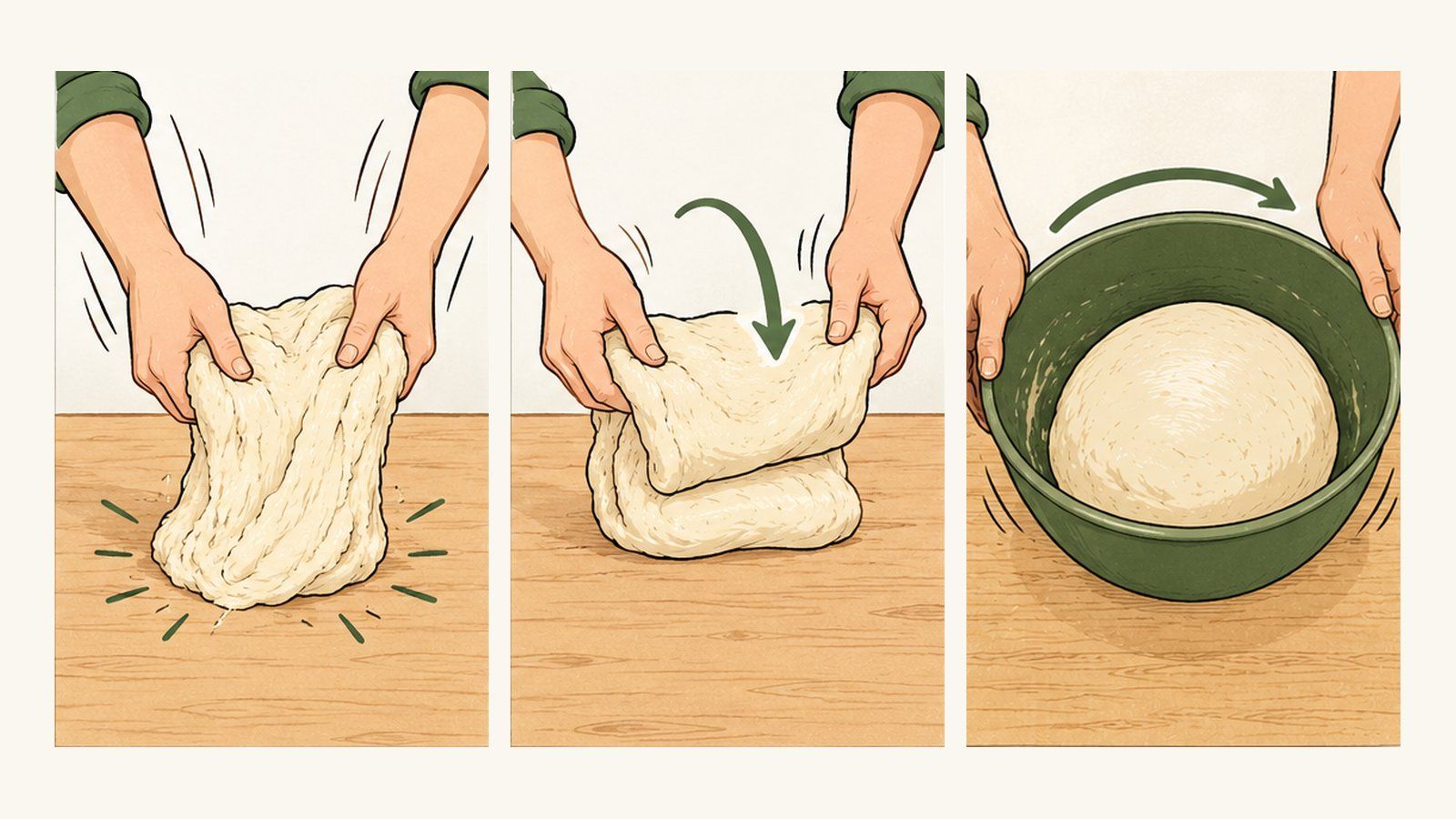
Every good loaf needs gluten: the stretchy network of protein that forms when flour meets water and gets worked. It is what traps the gas from the yeast and lets bread rise instead of spreading into a puddle. A stand mixer builds it for you. Without one, there are two techniques worth learning, and they do different jobs.
- Slap and fold replaces kneading. You do it once, right after mixing, for about ten minutes.
- Stretch and fold strengthens the dough while it rises. You do it a couple of times during bulk fermentation, and each round takes less than a minute.
Our everyday sandwich loaf uses both if you mix by hand: slap and fold to build the dough, then two rounds of stretch and fold while it ferments.
Slap and fold
Slap and fold (sometimes called French folding) is the best way to knead a wet, sticky dough. Normal kneading pushes the dough into the counter, which with a wet dough just leaves you with glued-up hands and a worktop covered in paste. Slap and fold does the opposite: it uses gravity and momentum to stretch the dough in the air, so it barely touches the counter at all.
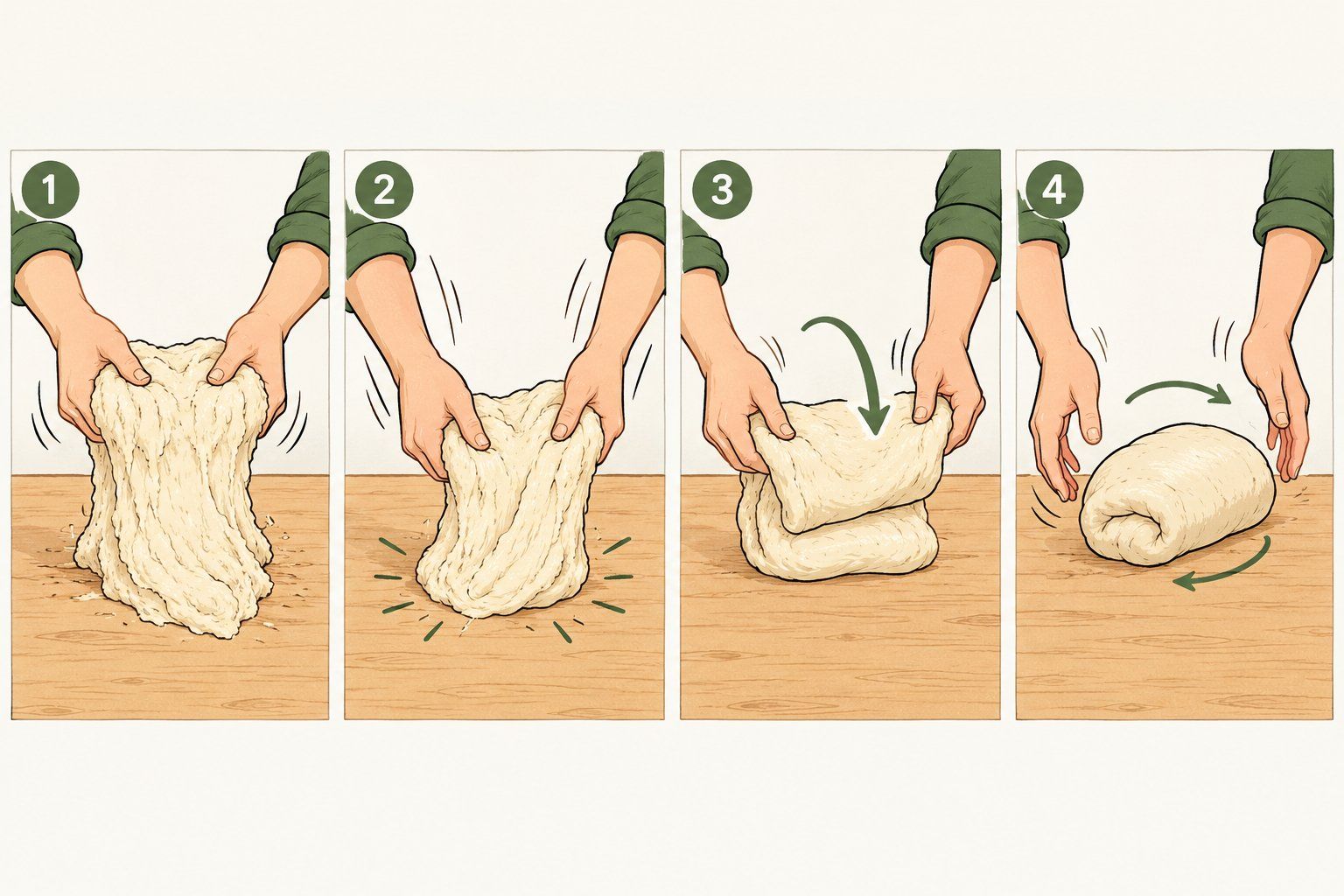
- Tip the dough out onto a clean, unfloured worktop. No flour and no oil: you need the dough to grip the counter slightly.
- Slide your fingers under the side of the dough nearest you, thumbs on top, and lift it up. Most of the dough will hang down from your hands.
- Swing it down and slap the hanging bottom onto the counter, keeping hold of the top edge.
- Pull the part in your hands gently towards you so the dough stretches, then fold it forward over the top of itself, like closing a book.
- Let go, turn your hands a quarter turn, pick the dough up again from the side, and repeat.
Find a rhythm of roughly one slap every two or three seconds. For the first three or four minutes the dough will stick to your fingers and the counter and you will be convinced it is not working. Keep going, and use a bench scraper to gather up anything left behind. Somewhere around minute five it starts to hold together, and by minute eight to ten it comes off the counter cleanly in one smooth, bouncy piece.
Resist the urge to add flour. Stickiness at the start is the dough being wet, not the dough being wrong, and the slapping fixes it.
How to tell it's done
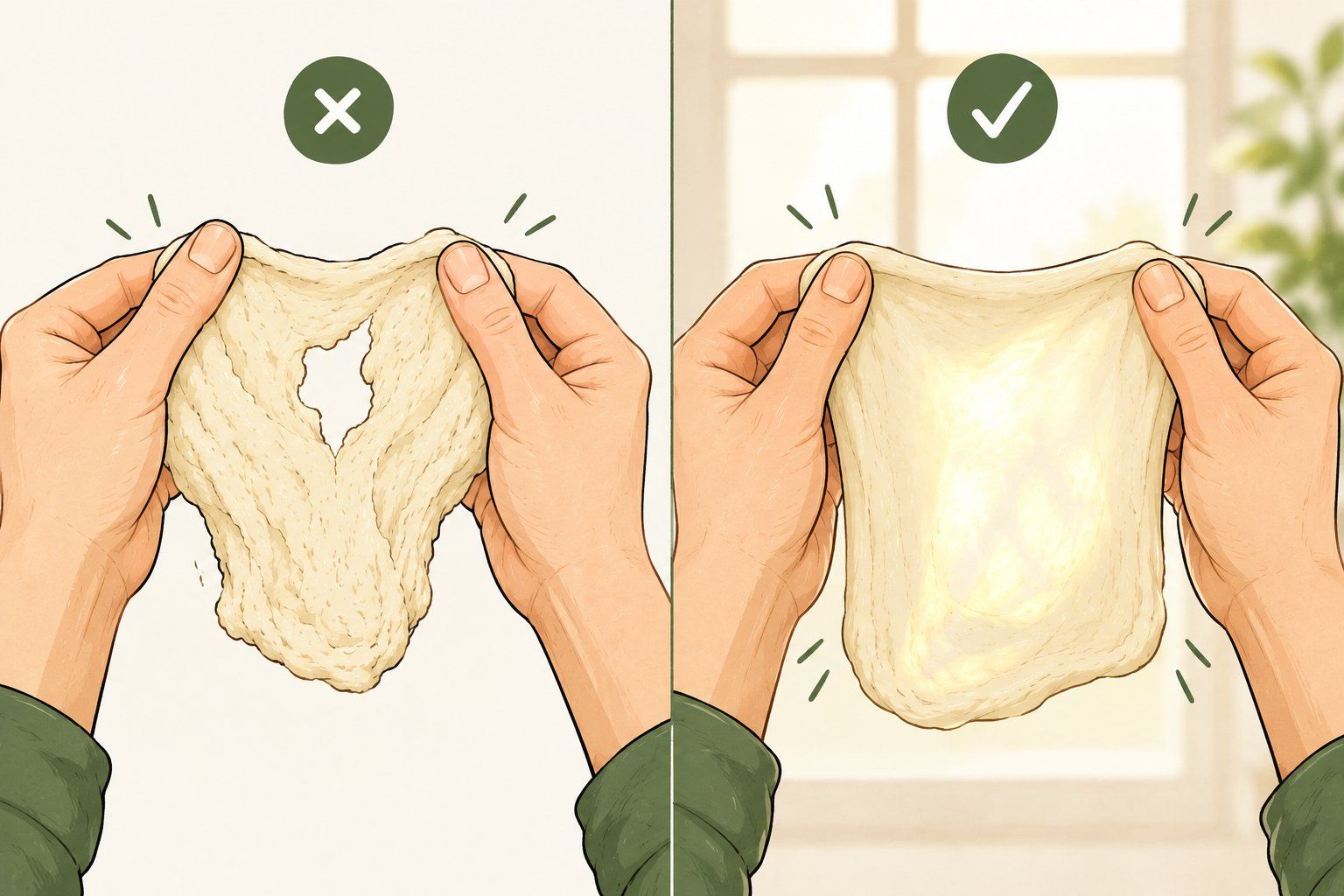
Look for three things: the dough is smooth rather than shaggy, it releases from the counter and your hands, and it springs back when you press it. For a final check, do the windowpane test. Pinch off a walnut-sized piece and gently stretch it between your fingers. If it goes thin enough to see light through before it tears, the gluten is well developed. If it rips straight away, give it another couple of minutes.
Stretch and fold
Stretch and fold happens later, while the dough is rising in its bowl. Each set gently stretches the gluten and folds it back over itself, which tightens the dough, evens out the temperature and gives the loaf more strength to hold its shape in the oven. It takes about thirty seconds and you never take the dough out of the bowl.
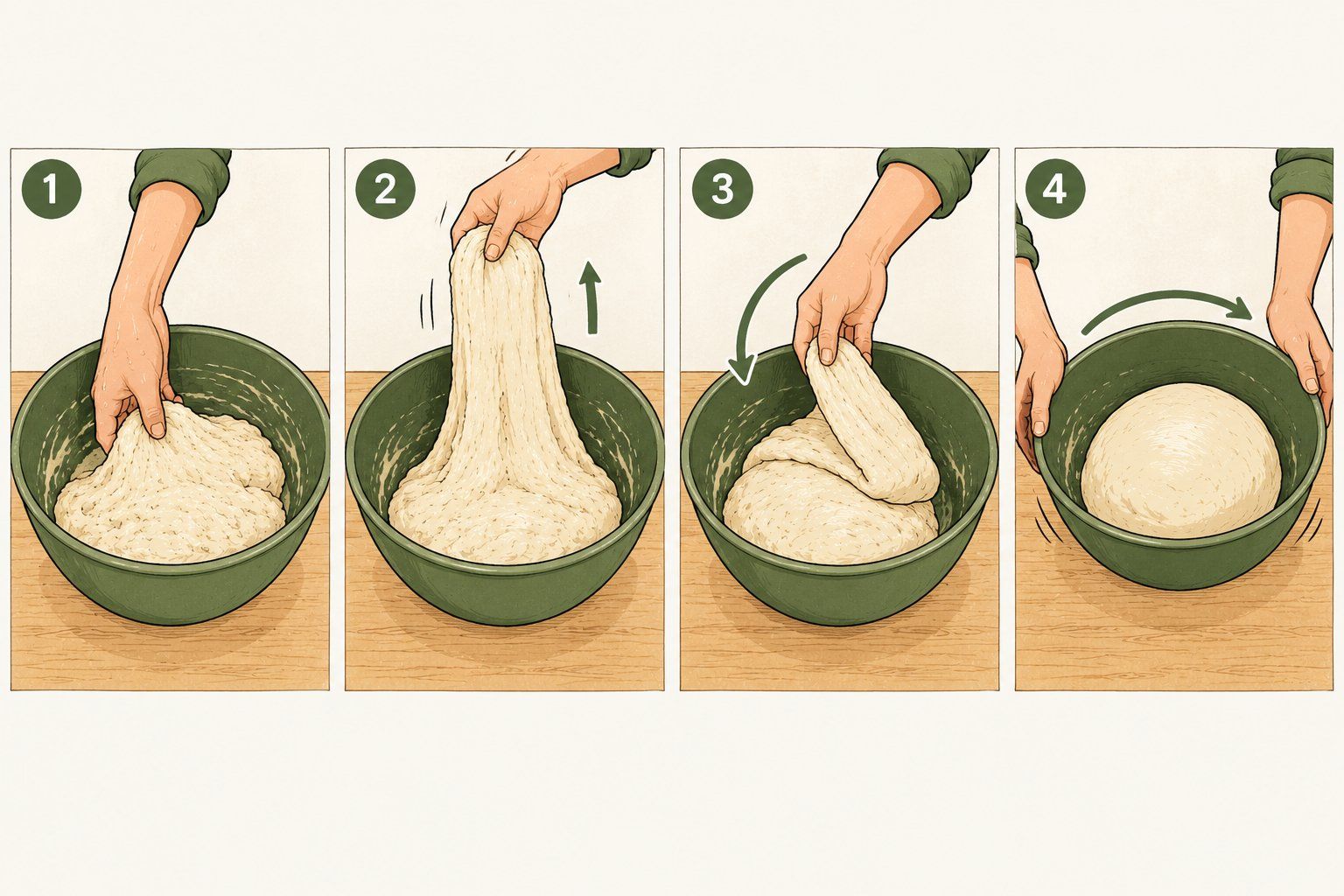
- Wet your hand with a little water so the dough doesn't stick to it.
- Slide your fingers down the side of the bowl, under the dough, and grab the edge furthest from you.
- Lift it straight up until you feel resistance. Stop before it tears.
- Fold it over the top of the dough and press it down on the opposite side.
- Turn the bowl a quarter turn and repeat, four times in total, so every side has been stretched once. That is one set.
- Cover the bowl again and leave it.
You will feel the difference immediately. Before a set, the dough is slack and spreads out flat in the bowl. After it, it sits up as a taut, rounded mound. By the second set it will resist more and you won't be able to stretch it as far, which is exactly what you want. In the sandwich loaf we do one set after 45 minutes and one after 1 hour 30 minutes, then leave the dough to finish rising undisturbed.
Which one when
- Right after mixing, with no machine: slap and fold, about 10 minutes.
- During bulk fermentation: stretch and fold, one set every 30 to 45 minutes, usually two to four sets.
- Mixed in a stand mixer: skip the slap and fold, but still do the stretch and folds. They do a different job.
- Very wet dough, or no energy for slapping: you can build a dough with stretch and folds alone, doing four to six sets 30 minutes apart. It takes longer but is almost no work.
When it goes wrong
- Dough still glued to the counter after ten minutes: it is either very wet or you are working too gently. Speed up the slaps and use the scraper more.
- Dough tears when you stretch and fold: you are pulling too far, or it needs more rest. Stretch only until you feel resistance.
- Dough sticks to your hand during stretch and fold: wet your hand again. Water, not flour.
- Loaf spreads flat in the oven: usually not enough strength. Add another set of stretch and folds next time, and shape a little tighter.
Both techniques feel awkward the first time and automatic by the third. After that you will know a well-developed dough by feel alone, which is worth more than any timer.